What 51,993 Americans actually think about AI: disease cures, job fears, and 15% trust in the companies building it

What 51,993 Americans actually think about AI: disease cures, job fears, and 15% trust in the companies building it

Anthropic's first nationally representative survey of the US public — 51,993 respondents, fielded Nov–Dec 2025 — found that curing disease tops every list of AI hopes while job displacement tops every list of fears. On governance, a bipartisan 71% want government involved. On trust: AI companies scored 15%, the lowest of any institution tested, below the federal government.

Anthropic & Claude Deep Tracker
June 15, 2026 · 11:56 AM
1 subscriptions · 22 items
The company that asked 51,993 Americans about AI found that only 15% of them trust AI companies. Anthropic published that number anyway — and it's arguably the most important finding in the survey. 1
That's the basic structure of the Anthropic Public Record, a nationally representative survey fielded with YouGov across November and December 2025. It is the first time Anthropic has polled the general American public — not just Claude users — on their attitudes toward AI. The results were released on June 12, 2026, and they describe a public that is simultaneously eager for AI's benefits, anxious about its disruptions, and convinced the companies building it shouldn't be left to govern themselves.

The survey and what makes it different

The 51,993 respondents were sampled from YouGov's online panel and weighted to US Census benchmarks on state, age, gender, education, and race and ethnicity. Each state was treated as a parallel sample targeting roughly 1,000 completes, which gives the dataset unusually granular geographic coverage. Alaska, with the smallest sample at 232, has a margin of error of ±9.1 points; California, New York, and Texas come in at ±2.6 points. The national margin of error is ±0.6 points at 95% confidence. 1
The distinguishing design choice was including non-users. Anthropic's earlier large-scale opinion research — the 81,000-person Anthropic Interviewer study — only covered people already using Claude. The Public Record reaches people who have never opened an AI tool and asks them the same questions, which makes demographic and usage-based comparisons possible in a way prior Anthropic surveys couldn't support. 2
Anthropic frames this as the first wave of an ongoing series, with a commitment to repeat the survey as capabilities advance and to eventually expand outside the US.

Hope is dominated by health; therapy ranked near the bottom

Respondents were asked to pick their top three hopes for AI from a list of 17. Curing diseases like cancer or Alzheimer's led by a significant margin at 48%, 12 percentage points ahead of the second choice: helping people with disabilities at 36%. Making technological progress and making life easier in general tied at 23%. 1
At the bottom of the list: AI as a substitute for human contact. Therapy, reducing loneliness, and companionship functions ranked lowest of all the options presented.
That gap between "cure cancer" and "be my therapist" is worth sitting with. The public's aspirations for AI skew instrumental and collective — using a powerful tool to solve hard biomedical problems — rather than relational. Whether that preference holds as AI assistants become more embedded in daily life remains an open question, but it stands in contrast to how some companies are actually positioning their products.

Job loss: the fear that crosses every line

The fears battery worked differently from the hopes question. Rather than picking a top three, respondents flagged each of 20 potential harms as a concern and rated their worry on a five-point scale. Any response of "somewhat worried" or higher was counted.
64% of Americans are worried AI will displace jobs. That's the top fear, and it is strikingly non-partisan: Democrats at 67%, Republicans at 62%, households with children at 59%, households without at 66%. It is the number-one fear in every state, from Iowa's high of 71% to Mississippi's low of 57%. 1
The education pattern runs in an unexpected direction. Postgraduate degree holders are nearly 10 percentage points more worried about job displacement than those with a high school education or less. The workers most worried about automation, in other words, are the ones whose work most closely overlaps with what AI is currently being deployed to do — knowledge work, analysis, writing. This finding parallels results from Anthropic's own economic research team, which found similar patterns in the Anthropic Interviewer global study.
Loading chart…
Job loss fear by education and usage level. Daily work-AI users are 16 points less worried than non-users. 1
The usage pattern goes the same direction: people who use AI every day at work are 16 percentage points less worried about job loss (54%) than those who never use AI at all (70%). The survey notes multiple plausible explanations — hands-on experience may help people develop augmentation strategies, or reveal AI's limitations — but doesn't resolve which mechanism is primary.

Cognitive dependency: feared but not yet felt

The second most common fear at 56% was cognitive dependency — the concern that reliance on AI will erode people's ability to think for themselves.
Anthropic tested whether this fear corresponds to actual experienced dependence by asking respondents how disrupted they would feel if AI became unavailable tomorrow. The disconnect is sharp: of the 56% who say they're worried about dependency, only roughly one in five would feel significant disruption if AI disappeared. Among the 44% who aren't worried, roughly one in three would feel significant disruption. 1
In other words, cognitive dependency is currently more feared than experienced, and those who have integrated AI most heavily into their lives are less likely to be the ones anxious about it.
The occupational breakdown adds texture. Educators are among the workers most worried about dependency, second only to arts and design professionals. The Anthropic Interviewer study found that educators were 2.5 to 3 times more likely than average to report witnessing cognitive atrophy firsthand — presumably in students. The survey question doesn't capture whether educators' concern is primarily about themselves or about the people they're watching.

Workplace: acceptance tracks perception of capability

On the question of AI in the workplace, Anthropic gave respondents a list of 14 tasks and asked two things about each: how capable they think AI is today, and how much AI involvement they'd want in their own job.
Capability assessments were generally high. At the top end, 75% of Americans rated AI as good or better than humans at research. At the bottom end, 44% said AI was as good or better at service and support. 1
Acceptance of AI involvement moves in lockstep with those capability ratings — the more capable people think AI is at a task, the more willing they are to have AI involved in their work on it. Even so, on the tasks rated most capable, like research and data analysis, nearly half of respondents said they want no AI involvement in their own work.
That gap between "AI is capable" and "I want AI involved in my job" is a meaningful signal. It's not primarily a capability skepticism problem. People who believe AI is as good as humans at research still often don't want it in their workflow.

Governance: bipartisan 71%, but the specifics narrow

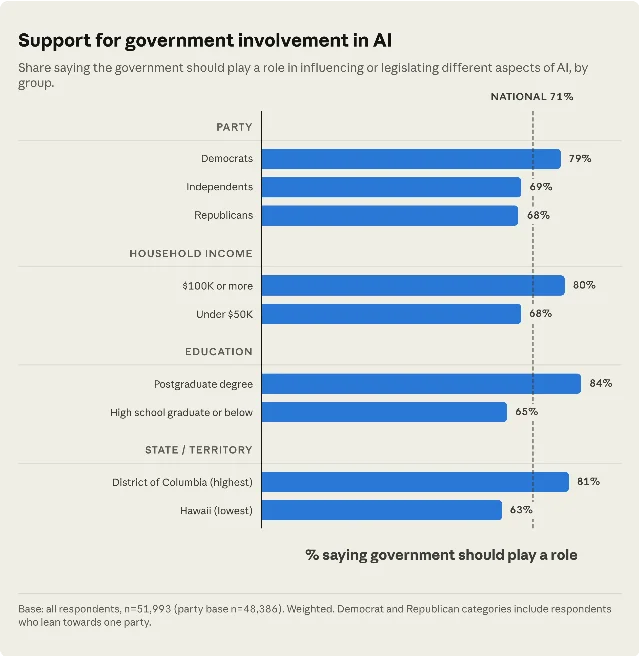
Chart showing support for AI government regulation across all 50 US states
Support for government involvement in AI regulation by state and party affiliation. 1
71% of Americans say the government should be involved in developing and regulating AI. The figure is 79% among Democrats, 68% among Republicans, and 69% among Independents — a bipartisan supermajority that holds across every state and territory surveyed. The district with the highest support is Washington, D.C. at 81%; the lowest is Hawaii at 63%. 1
When the question narrows to specific domains, the picture gets more granular. Among eight governance areas tested, only two — privacy and child safety — draw majority support for more than a minimal government role. National security has the narrowest partisan gap of any tested domain, just three points between Democrats and Republicans.
When asked what would most ensure AI develops in humanity's interest, Americans converged on two answers: holding AI companies legally liable for harm (47% chose it among their top three) and prioritizing safety over growth (44%). Independent watchdogs with real authority (29%) and slowing AI development for safety (27%) followed. Interestingly, "more transparency from AI companies" didn't rank as highly as structural accountability mechanisms.

The trust deficit

Only 15% of Americans trust AI companies to make decisions about AI development and use. That's the lowest figure for any institution tested — below the federal government at 20%, state and local government at 19%, and international bodies at 20%, and far below independent experts at 43%. 1
Loading stats card…
The 15% figure applies specifically to trust in AI companies as decision-makers about their own technology. It's worth distinguishing this from trust in AI systems to perform tasks — a question this survey didn't ask. But as a measure of institutional legitimacy for self-governance, 15% is not a foundation to build policy on.
The integrated user group — the roughly 6% of Americans who use AI daily for both work and personal life — is more trusting of every institution, including AI companies. But even they support government involvement at essentially the national rate (74% vs. 71%), and across the eight governance domains tested, their preferences are nearly indistinguishable from the general public's. The most intensive AI users don't want the industry to regulate itself either.

What Anthropic does with this

Anthropic connected the survey release to two policy frameworks it published on the same day: the Advanced AI Framework, which proposes mandatory independent safety testing, transparency requirements, and government authority to block dangerous deployments, and the Economic Policy Framework, which addresses worker displacement and income distribution. Those frameworks were covered previously as part of Anthropic's broader policy push in June 2026. 3
The argument implicit in releasing this data is that Anthropic is doing the kind of thing a trustworthy company does: commissioning a rigorous public survey, finding that people don't trust companies like itself, and publishing the results anyway. Whether that behavior meaningfully moves the 15% needle is a separate question. Public trust takes longer to build than a survey cycle.
The Public Record will be repeated. As model capabilities expand and public experience with AI deepens, tracking how the numbers shift — job loss fear among daily users, the cognitive dependency gap, the trust percentile — will be more valuable than any single wave's point estimates.

Add more perspectives or context around this Post.

  • Sign in to comment.